CLI usage
Everything Cards does is available from the cards binary. This page covers
getting it installed and wired to a project, the two backends, and the full
command surface. Per-operation examples with responses — including the HTTP
and MCP equivalents — are in using Cards.
Install
Grab your platform's archive from the
latest release
(linux / darwin / windows × amd64 / arm64):
$ curl -L -o cards.tar.gz \
    https://github.com/somebox/cards/releases/latest/download/cards_darwin_arm64.tar.gz
$ tar -xzf cards.tar.gz && sudo mv cards_darwin_arm64/cards /usr/local/bin/
$ cards version
On macOS, clear Gatekeeper quarantine on first run:
xattr -d com.apple.quarantine /usr/local/bin/cards.
Set up a project
$ cd my-project
$ cards init          # scaffolds ./.cards + installs .claude/skills/cards/
$ cards serve         # http://127.0.0.1:8787
cards resolves its workspace the way git finds .git/: the nearest
.cards/ walking up from the current directory, falling back to a personal
workspace at ~/.cards. cards init --global creates the personal one;
--workspace <dir> is always the explicit override.
init also installs the agent skill into .claude/skills/cards/ — the location
Claude Code and compatible harnesses read — next to the
workspace (--global installs it under your home directory instead, following
$HOME rather than $CARDS_HOME). It runs even when the workspace already
exists — that is how an established project picks up the skill — and never
overwrites an existing skill directory. To pick up a newer playbook, review any
local edits, delete .claude/skills/cards, and re-run cards init.
--no-skill opts out.
The matching short-form guidance served to MCP clients is printable with
cards mcp --print-instructions.
Two backends
Client commands (list, create, patch, …) work in either of two modes:
| Mode | When | How |
|---|---|---|
| Serverless (default) | No server running; scripts, CI, quick edits | Runs the same service in-process against the resolved workspace |
| Server | A cards serve is up |
Set CARDS_URL (or --url) to target it |
Prefer the server when one is running: a serverless write bypasses that
process's event bus, so its live board and hooks won't see the change.
--workspace applies to the serverless path only (combining it with --url
is an error).
Environment
| Variable | Purpose |
|---|---|
CARDS_URL |
API base. Unset = serverless. |
CARDS_WORKSPACE |
Workspace directory for serverless mode |
CARDS_USER |
Default actor for writes (--as overrides per command) |
Terminal UI
A bare cards (no command) opens an interactive terminal UI when stdin and
stdout are both TTYs and neither --json nor --jsonl is set. In scripts,
pipes, and agent shells it prints usage instead, so automation is unaffected.
The TUI runs serverless against the resolved workspace (same precedence:
--workspace → CARDS_WORKSPACE → discovery), opens the same in-process
service as the CLI backend, and refreshes live from the workspace event bus.
Quit with q or Ctrl-C.
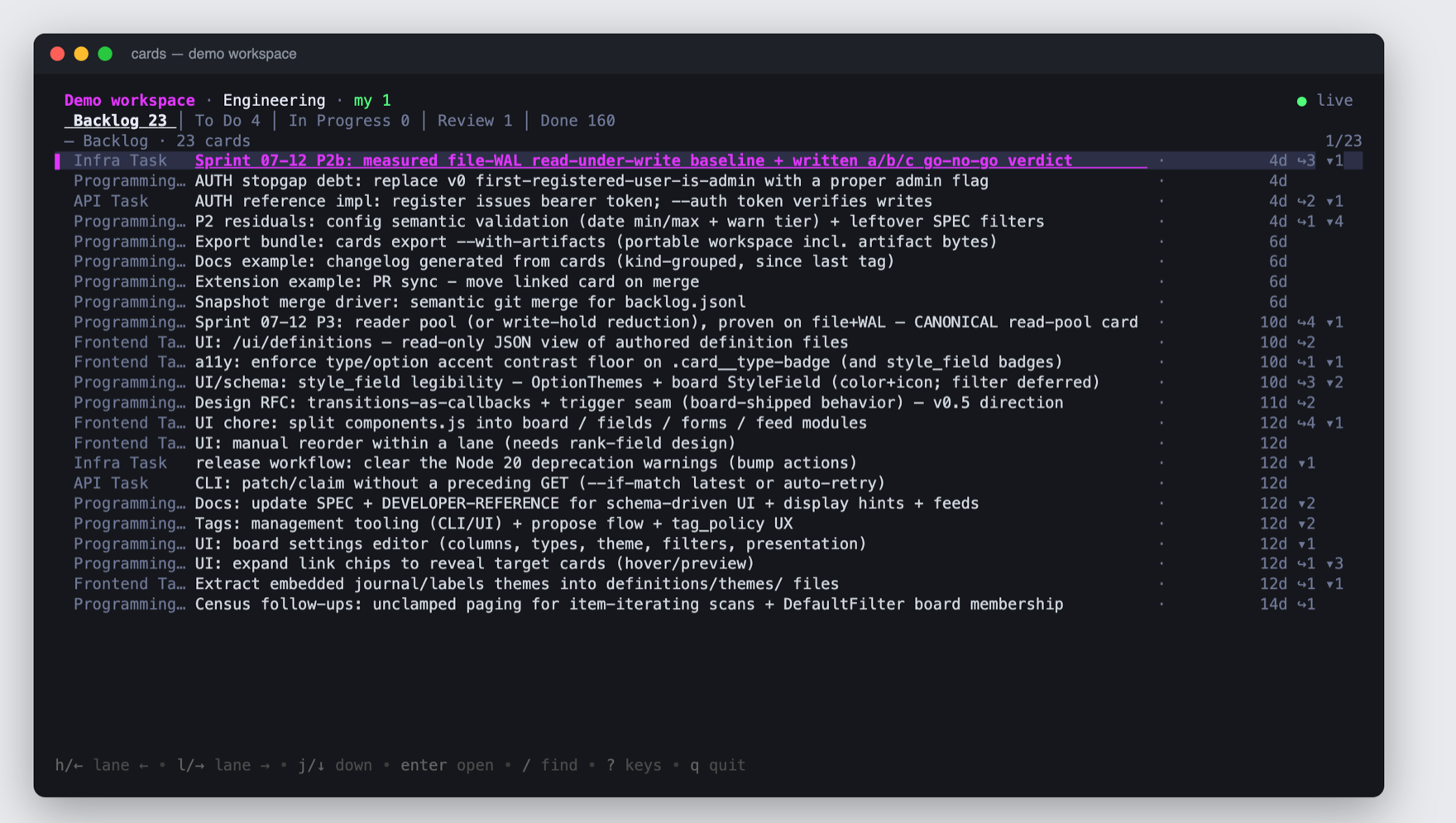
Layout and keys (full reference on ? in-app):
- Board columns are tabs:
h/l(or←/→) switches lanes,shift+tabswitches boards,kat the list top focuses the tab bar. j/kmoves the cursor (the list scrolls);/finds by text within the lane.- Query directives (the same surface the web UI uses):
fopens the filter prompt (filter terms, saved board filters,owner:me—meresolves to the acting user),Fcycles the sort presets shared with the web UI,Tnarrows by card type. Active directives survive live refreshes. enteropens the selected card as a markdown document (schema fields, in/outbound links, comments, activity) in a split pane;enteragain makes it fullscreen;escsteps back fullscreen → split → list-only.- Actions:
sset status (numbered legal transitions from the board's transition map),oassign owner,eedit title,ccomment,mclaim/release,nnew card.
Mutations go through the same service calls as cards patch/comment/
claim, with optimistic concurrency (a stale write surfaces as a flash and
the card reloads) and the actor from --as / CARDS_USER / $USER /
workspace default_user.
Commands
Global flags on every command: --url, --as, --workspace, --json,
--jsonl, --quiet/-q. Run cards <command> --help for a command's flags.
Working with cards
| Command | Purpose |
|---|---|
list |
List/search: --board --owner --status --type --q --blocked --has-link --link-target --limit --cursor; --include links,comments |
get <id> |
One card (short ids work: 4430ab22) |
create |
--type T --title T [--status S] [--field k=v]… [--tag t]… [--dry-run] |
patch <id> |
--version N [--title] [--status] [--owner] [--field k=v]… [--dry-run] |
claim <id> |
Take ownership: --version N [--status S] |
release <id> |
Clear ownership: --version N [--status S] [--force]; --force permits an off-graph recovery move |
take-next |
Atomically claim the next eligible card: [--type] [--board] [--assign-to] [--status] [--filter-file] |
delete <id> |
Delete (leaves a tombstone event) |
comment add <id> / comment <id> / comment edit <id> <comment_id> |
--body B. comment <id> --body B is an alias for add. |
append <id> <field> |
Add a repeating entry: --version N --entry-json '{…}' |
patch-entry / remove-entry <id> <field> <entry_id> |
Edit/remove an entry |
link add/remove <id> |
--type T --target ID [--note N] |
attach <id> <field> <file> |
Upload to an artifact field |
upgrade-schema <id> |
[--target N] [--dry-run] |
Reading history and state
| Command | Purpose |
|---|---|
history <id> |
Resumption-ready timeline (creates, moves, comments, entries) |
events <id> |
Raw events with diffs: [--types t1,t2] [--limit N]; events stream follows live |
feed |
Workspace-wide event feed |
breaches |
Current WIP / drained-lane / blocked conditions |
workspace show |
Full introspection: columns, types, boards, users. settings.default_board names the primary board when the workspace declares one — bare cards (TUI) opens it, and take-next with no --board/--type draws from it. |
boards show [id] |
Board definition |
Workspace lifecycle
| Command | Purpose |
|---|---|
init [dir] [--global] |
Scaffold a workspace |
serve |
[--workspace] [--port 8787] [--seed] [--run-extensions] [--watch] |
mcp |
stdio MCP server ([--workspace]) |
reload |
Reload definitions on a running server |
export |
Snapshot to JSONL: [--out F] [--state-only] [--with-artifacts] — see the workflow |
import |
Restore a snapshot (--in F [--with-artifacts]; refuses a non-empty DB) |
users register |
--id ID [--kind human\|agent] [--display-name N] |
run-extensions |
Run the hook supervisor standalone |
do <id> [--param k=v] |
Invoke a run extension |
extensions [show <id>] |
List declared extensions |
version |
Version, commit, build info |
Output modes
--json— one JSON object (default forget,create,patch).--jsonl— newline-delimited JSON (default forlist,events).--quiet/-q— ids only; built forxargsand shell pipelines.- Errors are structured messages on stderr —
code (field): message
  [valid: …]
, e.g.unknown_enum (kind): Unknown enum value. [valid: feature, bug, design, infra]— the same error catalog as the API.
$ cards list --board engineering --status in_progress | jq -r .title
Add rate limiting to /v1
Fix cursor pagination off-by-one

$ cards list --status done -q | xargs -n1 cards get -q
Card references
Anywhere a command takes a card id, the 8-character short id shown on the
board works (4430ab22). An ambiguous short id is never auto-resolved — the
command fails listing every candidate so you can pick. References are
normalized to full ids before writing, so events and links always record full
ids.
Concurrency
Pass --version on every patch / claim / release / entry mutation. A
stale version exits with version_conflict and the current card on stderr —
re-read, retry. release --force is the explicit recovery operation that may
bypass a board transition while clearing ownership; ordinary patches remain
transition-checked.