Card definitions
A card type is one JSON file under definitions/card-types/. That file is the
contract: it drives the web form, the API validation, the CLI flags, and the
generated MCP tools. This page covers authoring them.
{
  "id": "programming-task",
  "name": "Programming Task",
  "schema_version": 1,
  "fields": [
    { "id": "description", "type": "text",
      "required": true, "display": "monospace" },
    { "id": "branch", "type": "string",
      "required": true, "display": "badge" },
    { "id": "kind", "type": "enum",
      "options": ["feature", "bug", "design", "infra"] },
    { "id": "work_log", "type": "repeating",
      "display": "feed",
      "item_fields": [
        { "id": "commit_hash", "type": "string",
          "required": true },
        { "id": "notes", "type": "text" }
      ] }
  ],
  "allowed_columns": ["backlog", "todo",
    "in_progress", "review", "done"]
}
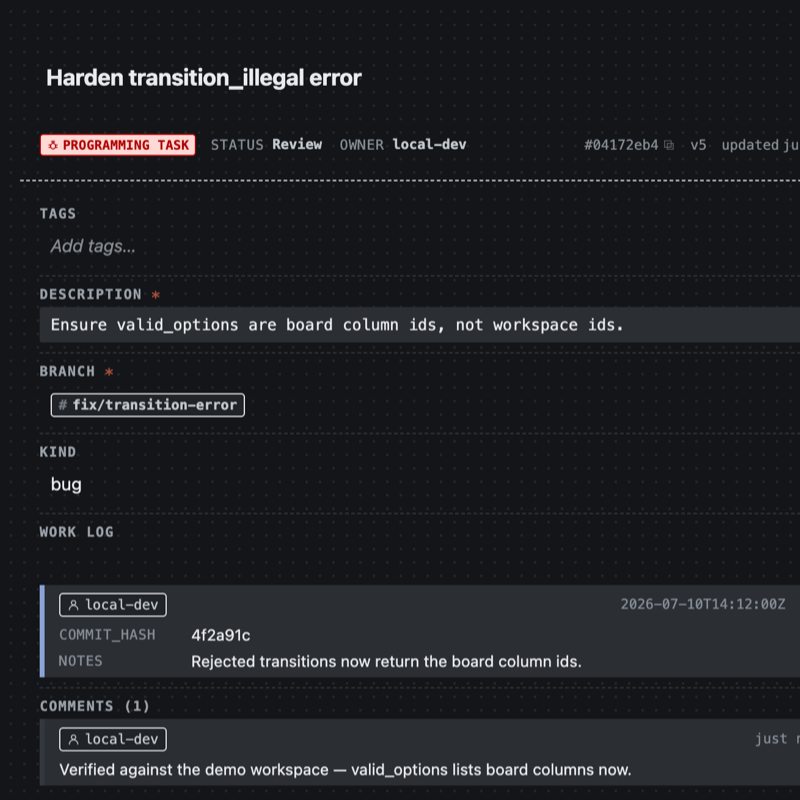
The envelope vs. your fields
A schema is not fully free-form: every card shares a universal envelope the
runtime manages, and your card type defines only the shape of fields. The
two files relate by id — the id at the top of the definition
(programming-task above) is what every card created from it carries as its
type_id.
| Property | On create | On update | Notes |
|---|---|---|---|
id |
Server-generated | Immutable | Stable string; used in URLs and links |
type_id |
Required | Immutable | The definition's id (e.g. programming-task) |
schema_version |
Defaults to current | Via upgrade-schema only |
Pins validation rules |
title |
Required | PATCH | Not part of fields; always indexed for search |
status |
Required (or first allowed column) | PATCH | Always a workspace column id |
fields |
Per type schema | PATCH / entry APIs | Your typed custom data |
owner |
Optional | PATCH | The canonical assignment field (claim, take-next, owner=me) |
tags |
Optional | PATCH | Subset of the workspace tag_set |
links / comments |
— | Link / comment APIs | Envelope features, not schema fields |
version |
1 |
Increments per mutation | Optimistic concurrency |
Don't redefine title or status inside fields. Multiple assignees or
reviewer roles are extra schema fields (user, or repeating with a user
item).
Defining a field
{
  "id": "machine_key",
  "label": "Human label",
  "type": "string",
  "required": false,
  "default": null,
  "description": "Shown in introspection — write it for the agent."
}
The ten field types, with their extra keys:
| Type | Holds | Extra keys |
|---|---|---|
string |
Single line | — |
text |
Multi-line, rendered as markdown | — |
number |
Numeric | min, max |
date |
RFC3339 timestamp | min, max (as Unix seconds UTC — a date string here is a load error) |
enum |
One of a fixed set | options: [...], multiple: true, option_themes |
tags |
Workspace tags | uses the workspace tag_set |
user |
A registered user id | multiple: true |
card_link |
Reference to another card | target_type, link_type |
repeating |
An append-only feed of typed entries | item_fields: [FieldDef, ...] (no nesting); entries get a server entry_id |
artifact |
A stored file or URI | artifact_policy — "local" or "uri" |
Details worth knowing:
- Multi-value (
enum/userwithmultiple: true) — the value is always an array when present and absent when unset (nevernullor[]).requiredmeans non-empty; filter with$has. Not available insiderepeatingitems. - Display hints — a field may carry
display: "badge" | "monospace" |
  "feed" | "hidden" | "link"
to shape how the UI renders it, and enum fields may map values to icons and colors withoption_themes. Presentation only; no effect on validation. searchable_fields— an optional type-level list of field ids (usuallytext/string) indexed for full-text search alongsidetitle. Declaring it restricts the index to those fields; omitting it indexes every field value.titleis always searchable either way. Narrowing (or widening) the list re-indexes existing cards on the next load, so a field you exclude stops matching immediately rather than lingering in the index.allowed_columns— an optional type-level subset of workspace columns;statusmust stay inside it even when no transition graph is enforced.- Richer payload validation (JSON schemas, file paths, commands) is not a
field type — store as
text/artifactand validate in an extension.
It's just JSON — pipe it
Definitions and card output are both plain JSON, so ad-hoc questions are one-liners. What enums does this type have? How is in-flight work distributed?
Layered validation
Rules merge workspace → card type → board → card, and later layers only add restrictions — a board can tighten a type's rules, never loosen them. The normative merge order lives in the data-model spec.
Schema versioning
Every card records a schema_version, and reloading definitions never migrates
existing cards automatically. The runtime currently loads only the latest type
definition, however, so ordinary writes validate against that current schema —
not an immutable historical snapshot. True pinned-version validation and
serving old type definitions remain unbuilt.
To evolve a type, bump schema_version and describe the step in
migrations. The current definition is the complete target field list — a
field you leave out is dropped when a card explicitly upgrades (the dry-run
shows exactly what would be lost), so carry forward everything you keep:
{
  "id": "programming-task",
  "name": "Programming Task",
  "schema_version": 2,
  "migrations": {
    "2": { "from": 1, "summary": "Completed cards carry a visual proof where appropriate",
           "field_defaults": { "screenshot": null } }
  },
  "fields": [
    { "id": "description", "type": "text", "required": true, "display": "monospace" },
    { "id": "branch", "type": "string", "required": true, "display": "badge" },
    { "id": "kind", "type": "enum",
      "options": ["feature", "bug", "design", "infra"] },
    { "id": "screenshot", "type": "artifact", "artifact_policy": "local" },
    { "id": "work_log", "type": "repeating", "display": "feed",
      "item_fields": [
        { "id": "commit_hash", "type": "string", "required": true },
        { "id": "notes", "type": "text" }
      ] }
  ],
  "allowed_columns": ["backlog", "todo", "in_progress", "review", "done"]
}
Cards upgrade explicitly, per card (dry-run first):
Over MCP the upgrade_schema tool defaults to dry-run (confirm: true
applies). Each upgrade emits a schema_upgraded event. A field may be marked
deprecated: true within a version as advance warning; actual removal is a
new version. Normative change rules:
schema versioning in the spec.
What you don't get (v1)
- Per-type column names — columns are workspace-wide; types only restrict the subset.
- Nested
repeatinginside repeating items. - Structured-payload field types (
json,path,command) — extension territory.
Next
- Workspace & boards — columns, link types, transitions, and board configuration.
- Card type examples — complete worked schemas (research goal, fabrication job).
- Using Cards — creating and updating cards against these schemas from CLI, HTTP, and MCP.